Why Self-Awareness Is the Foundation of Every Other EQ Skill

The Uncomfortable Math
Here's a statistic that should make you pause: in a series of studies involving nearly 5,000 participants, organizational psychologist Tasha Eurich found that while 95% of people believe they're self-aware, only about 10-15% actually demonstrate it (Eurich, 2017).
That's not a small discrepancy. That's a chasm. And it has consequences that ripple through every other emotional intelligence competency.
Think about it. If you can't accurately identify what you're feeling, you can't regulate it. If you don't understand your own triggers, you can't prevent yourself from being blindsided by them. If you're unaware of how others perceive you, your attempts at empathy and influence are built on faulty assumptions.
Self-awareness isn't just one EQ skill among many. It's the operating system that everything else runs on.
What Self-Awareness Actually Means
Eurich's research makes a crucial distinction between two types of self-awareness that most people conflate:
Internal self-awareness is understanding your own values, passions, aspirations, reactions, and impact on others. It's knowing what you feel and why. People high in internal self-awareness make choices that align with their actual values rather than defaulting to social expectations or unconscious habits.
External self-awareness is understanding how other people see you. This isn't about being paranoid or people-pleasing - it's about having an accurate map of your reputation, your perceived strengths and weaknesses, and the effect your behavior has on the people around you.
Here's what makes Eurich's research particularly interesting: these two types are essentially independent. You can be deeply introspective without having any idea how others experience you. You can be highly attuned to others' perceptions while remaining a stranger to your own inner workings.
The people who demonstrate genuine self-awareness score high on both dimensions. And they're rare.
The Neuroscience of Self-Awareness
Self-awareness isn't just a psychological concept - it has a neurological basis. The anterior insular cortex, a region deep in the brain's folds, plays a critical role in interoception: the ability to sense your own body's internal states (Craig, 2009). Heart rate, gut feelings, muscle tension, breathing changes - these physical signals are often the earliest indicators of an emotional response.
People with higher interoceptive accuracy - those who can, for example, count their own heartbeats without touching their pulse - tend to experience emotions more intensely and report greater emotional awareness (Critchley & Garfinkel, 2017). This suggests that self-awareness begins in the body, not the mind.
The prefrontal cortex, particularly the medial prefrontal cortex, handles the more reflective aspects of self-awareness: thinking about your own thoughts, evaluating your behavior against your values, and projecting how others might perceive you. This region develops well into adulthood and remains plastic throughout life, which is good news for anyone who feels their self-awareness could use work.
Why Introspection Often Backfires
Here's a counterintuitive finding from Eurich's research: people who spend more time introspecting are not necessarily more self-aware. In some cases, they're actually less self-aware.
The problem isn't reflection itself - it's the type of reflection. Eurich found that people who ask "why" questions ("Why did I react that way?" "Why do I always do this?") tend to generate plausible-sounding explanations that feel true but aren't necessarily accurate. The human brain is a narrative machine; it will always produce a story. But the story is often wrong.
More effective self-reflection uses "what" questions. "What was I feeling in that moment?" "What are the situations that trigger this response?" "What do I want to do differently next time?" These questions focus on observable patterns rather than speculative causes, and they tend to produce more actionable insight.
This finding aligns with the broader cognitive science literature on confabulation - the well-documented tendency for people to construct post-hoc explanations for their behavior that sound reasonable but have little connection to the actual causes (Nisbett & Wilson, 1977).
The Self-Awareness Deficit in Leadership
The self-awareness gap is particularly pronounced - and particularly costly - among leaders. A study by Green Peak Partners and Cornell University examined 72 executives at public and private companies and found that a high self-awareness score was the strongest predictor of overall leadership effectiveness (Green Peak Partners, 2010).
Yet the same research shows that self-awareness often decreases as people climb the organizational ladder. The reasons are structural, not personal:
-
Power reduces perspective-taking. Dacher Keltner's research at UC Berkeley (2016) demonstrates that people in positions of power become less attuned to others' emotions and perspectives over time. The neurological basis for empathy literally diminishes with sustained power.
-
Feedback dries up. The higher you rise, the fewer people are willing to tell you the truth. Subordinates filter their honesty. Peers are competitors. The information environment becomes increasingly distorted.
-
Success reinforces blind spots. If your approach has "worked" (you've been promoted, you've hit targets), there's little incentive to question it - even if your success came despite your interpersonal deficits rather than because of your strengths.
This creates a paradox: the people who most need self-awareness - leaders whose decisions affect many others - are structurally positioned to have the least of it.
Building Self-Awareness: What Actually Works
Given that traditional introspection is unreliable and that our self-perceptions are systematically biased, how do you actually become more self-aware?
Seek External Data
The single most effective self-awareness intervention, according to Eurich's research, is actively seeking honest feedback from people she calls "loving critics" - individuals who care about you enough to be truthful and are skilled enough to deliver that truth constructively.
360-degree assessments formalize this process. When multiple colleagues independently describe the same pattern in your behavior, it's hard to dismiss as a one-off or a misunderstanding. The data becomes difficult to argue with.
The key is asking specific questions. "How am I doing?" invites vague reassurance. "What's one thing I do in meetings that might undermine my effectiveness?" invites actionable honesty.
Develop Interoceptive Awareness
Since emotional awareness begins in the body, practices that strengthen interoception also strengthen self-awareness. Mindfulness meditation is the most researched approach - a meta-analysis by Khoury et al. (2013) found significant positive effects on self-awareness across 209 studies.
But you don't need a formal meditation practice. Simple body-scan exercises, pausing throughout the day to notice physical sensations, or even keeping a brief physical-state journal can build the connection between body and emotional awareness.
Create Feedback Loops
Real-time feedback accelerates self-awareness development in ways that periodic reflection cannot. This might look like:
- Post-meeting check-ins with a trusted colleague: "How did I come across in that discussion?"
- Journaling immediately after charged interactions while the emotional data is still fresh
- Working with a coach who can observe patterns you can't see from inside your own experience
The speed of the feedback loop matters. Learning that you come across as dismissive three months later in an annual review is far less useful than hearing it within hours of the specific behavior.
Track Patterns, Not Incidents
Individual emotional reactions are noisy data. The signal emerges from patterns over time. Effective self-awareness practice involves noticing recurring themes:
- Are there specific types of people who consistently trigger frustration?
- Do you tend to shut down or escalate under pressure?
- What time of day are you most reactive?
- Which topics make you defensive?
Pattern recognition transforms scattered self-observations into genuine self-knowledge.
Self-Awareness as an Ongoing Practice
One of the most important things to understand about self-awareness is that it's not a destination. You don't "achieve" self-awareness and then move on to the next competency. It's a continuous practice that deepens over time and requires ongoing attention.
Your emotional patterns shift as your life circumstances change. A leadership transition, a personal loss, a new team dynamic - each creates new terrain to map. The self-awareness you developed in your previous role doesn't automatically transfer to your current one.
This is part of why coaching is so effective for self-awareness development. A good coach serves as a consistent external mirror, helping you notice what you've stopped noticing. Research by Grant (2014) found that executive coaching produced significant improvements in self-awareness, with effects that persisted well beyond the coaching engagement.
The Downstream Effects
When self-awareness improves, other EQ competencies tend to follow. This isn't automatic - you still have to do the work - but self-awareness creates the preconditions:
- Self-regulation becomes possible because you can catch emotional reactions earlier in the cycle
- Empathy improves because understanding your own emotions gives you a richer vocabulary for understanding others'
- Communication sharpens because you're more aware of the gap between your intent and your impact
- Conflict management gets easier because you can distinguish between your emotional reaction and the actual issue at hand
Eurich calls self-awareness a "meta-skill" - a capability that enables the development of other capabilities. That framing matches what we see consistently in coaching practice: the clients who make the fastest progress in any EQ competency are almost always the ones who've done foundational self-awareness work first.
Where to Start
If you're interested in assessing your own self-awareness across both internal and external dimensions, a structured assessment is the most efficient starting point. Nora's EQ assessment measures self-awareness as one of 20 competencies and provides specific, actionable feedback on where your perception of yourself might diverge from reality.
But even without a formal assessment, you can start today: ask someone you trust to describe your three greatest strengths and your biggest blind spot. Then sit with whatever they say - especially the parts that surprise you. The surprise is where the growth lives.
Nora Coaching
Editorial
The team behind Nora, building the future of AI-powered EQ coaching.
Related Articles
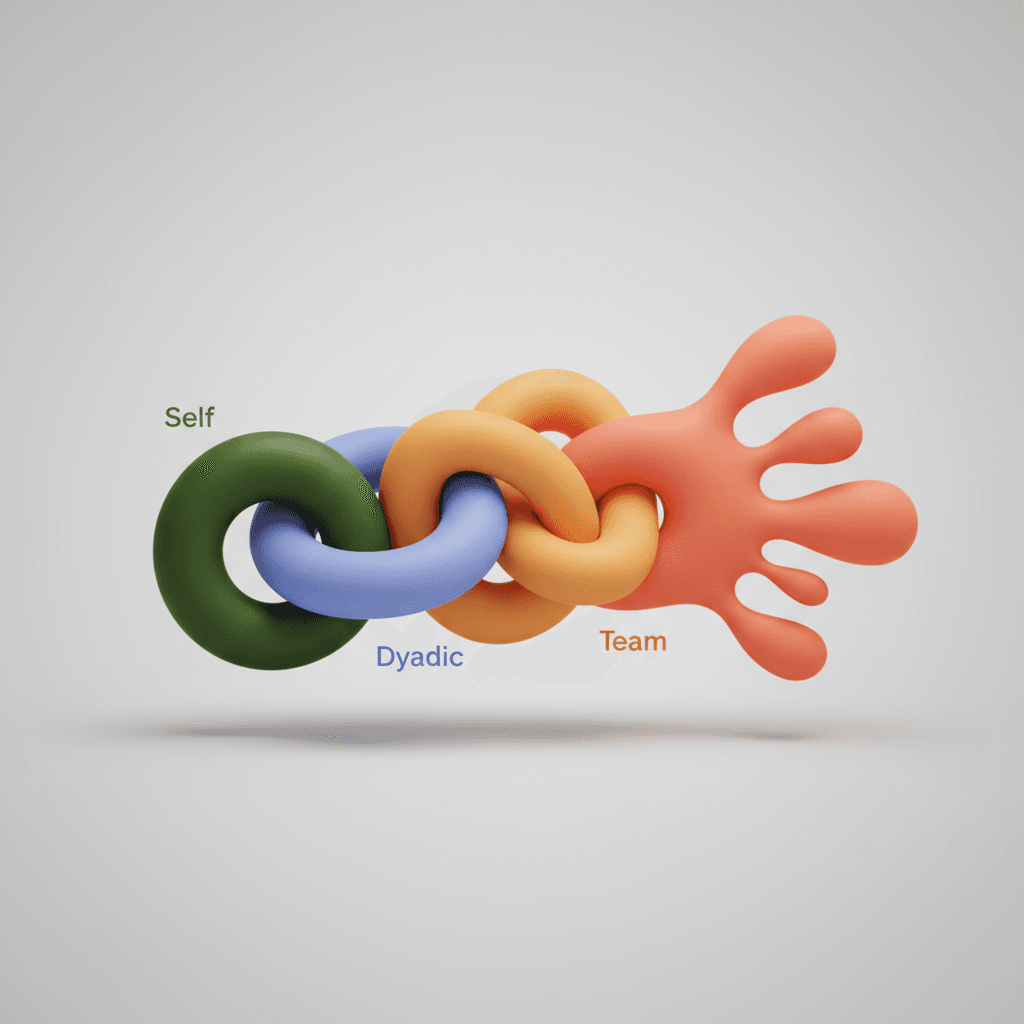
The Four Domains of EQ: Self, Dyadic, Team, and Organizational
Most EQ models stop at the individual. Here's why that's a problem - and how a four-domain framework gives you the full picture.
EQ vs IQ: Why the Debate Misses the Point
The question isn't whether EQ or IQ matters more. The research shows they serve different functions - and the interaction between them is what predicts success.

The Three Types of Empathy and Why You Need All of Them
Empathy isn't a single skill. It's three distinct capabilities - and overrelying on any one of them creates predictable problems.