The Four Domains of EQ: Self, Dyadic, Team, and Organizational
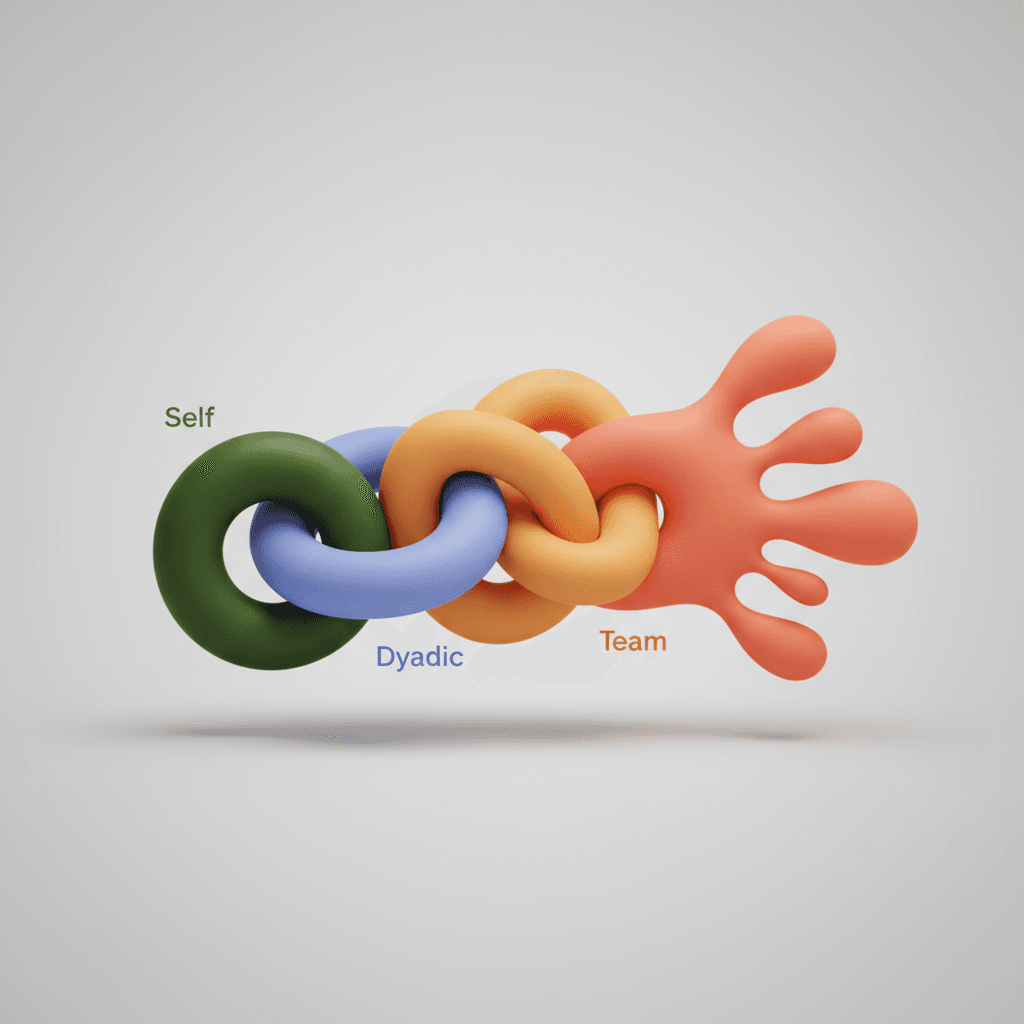
Why Most EQ Frameworks Feel Incomplete
If you've ever taken an emotional intelligence assessment, you probably received a score that described you - your self-awareness, your empathy, your emotional regulation. That's useful, but it misses something fundamental.
Emotional intelligence doesn't just operate inside individuals. It operates between people, within teams, and across entire organizations. A brilliant manager with sky-high personal EQ scores can still create a toxic team culture. A company full of empathetic individuals can still have organizational norms that crush psychological safety.
The traditional models - Goleman's five-component framework, Bar-On's EQ-i, Salovey and Mayer's ability model - all center on individual capabilities. They answer the question "How emotionally intelligent is this person?" But in most real-world contexts, the more important question is: "How emotionally intelligent is this system?"
That's the gap a four-domain framework addresses.
The Four Domains
Domain 1: Self
The Self domain is where every EQ model begins, and for good reason. You can't effectively manage relationships with others if you're a stranger to your own emotional landscape.
This domain draws from Goleman's Emotional Competence Inventory (ECI), Bar-On's intrapersonal scales, and Carol Dweck's growth mindset research (2006). It covers five core competencies:
Emotional Self-Awareness - The ability to recognize your emotions as they happen, understand their causes, and notice how they influence your thoughts and behavior. Tasha Eurich's research (2017) distinguishes between internal self-awareness (understanding your own patterns) and external self-awareness (understanding how others perceive you). Most people overestimate their abilities in both.
Emotional Self-Regulation - Managing your emotional responses so they serve you rather than derailing you. This isn't suppression - James Gross's process model of emotion regulation (1998) identifies multiple strategies from situation selection to cognitive reappraisal, each appropriate in different contexts.
Adaptability - Flexibility in response to changing circumstances. Bar-On's research positions this as a core EQ competency: the ability to adjust your emotions, thoughts, and behaviors to unpredictable situations without losing effectiveness.
Achievement Orientation - Internal drive toward meaningful goals, connected to intrinsic motivation rather than external rewards. Deci and Ryan's Self-Determination Theory (1985) provides the theoretical backbone here.
Positive Outlook - Not toxic positivity, but a realistic optimism that maintains forward momentum even during setbacks. Seligman's learned optimism research (1991) demonstrates that explanatory style - how you interpret negative events - is trainable and consequential.
Domain 2: Dyadic
The Dyadic domain governs one-on-one relationships. This is where empathy, communication, and trust live - the connective tissue between individuals.
The theoretical foundations include Goleman's social awareness competencies, Marshall Rosenberg's Nonviolent Communication (NVC) framework (2003), and the Crucial Conversations model developed by Patterson, Grenny, McMillan, and Switzler (2002).
Empathy - Understanding others' emotional states. Paul Ekman's research distinguishes three varieties: cognitive empathy (understanding someone's perspective), emotional empathy (feeling what they feel), and compassionate empathy (being moved to help). All three matter, and they don't always travel together.
Influence - The ability to have a positive impact on others' thinking and behavior. Not manipulation - genuine influence requires understanding what the other person values and framing your communication accordingly. Cialdini's work on persuasion principles (2001) informs this competency.
Conflict Management - Navigating disagreements productively. The Thomas-Kilmann Conflict Mode Instrument identifies five styles (competing, collaborating, compromising, avoiding, accommodating), and emotional intelligence involves knowing which to deploy when.
Communication - Clear, emotionally attuned expression and active listening. Rosenberg's NVC model - observations, feelings, needs, requests - provides a practical structure for conversations that could easily go sideways.
Coaching Orientation - The ability to develop others through questions, feedback, and support rather than directing or fixing. This competency distinguishes managers who grow people from managers who merely manage tasks.
Domain 3: Team
Here's where the framework departs from most traditional EQ models. Team-level emotional intelligence isn't just the average of individual scores - it's an emergent property of group norms, shared practices, and collective habits.
Amy Edmondson's groundbreaking research on psychological safety (1999) anchors this domain, alongside Deci and Ryan's Self-Determination Theory applied to group contexts.
Teamwork & Collaboration - The ability to work effectively in groups, share information freely, and prioritize collective outcomes. Google's Project Aristotle (2015) found that the best teams weren't composed of the best individuals - they were composed of people who interacted in specific, emotionally intelligent ways.
Team Empathy - Reading the emotional temperature of a group. This includes noticing when someone has checked out of a meeting, when a team is approaching burnout, or when unspoken tension is undermining collaboration.
Psychological Safety - Edmondson defines this as a shared belief that the team is safe for interpersonal risk-taking. In psychologically safe teams, people ask questions, admit mistakes, and propose wild ideas without fear of punishment or humiliation. This isn't a personality trait of the leader - it's a group-level condition that requires deliberate cultivation.
Shared Identity - The sense of belonging and common purpose that transforms a collection of individuals into an actual team. When shared identity is strong, people make sacrifices for the group without being asked. When it's weak, turf wars and silos emerge even among people with excellent individual EQ.
Collective Motivation - The team's shared drive and energy. Individual motivation matters, but teams can also develop collective momentum - or collective learned helplessness. This competency involves sustaining group energy through setbacks and celebrating progress meaningfully.
Domain 4: Organizational
The broadest domain addresses how emotional intelligence scales across an entire organization. This is the realm of culture, change management, and systemic influence.
Kotter's eight-step change model (1996), Cialdini's influence principles, and Bass's transformational leadership framework (1985) provide the theoretical grounding.
Organizational Awareness - Reading the political and social currents within an organization. Who has informal influence? What are the unspoken rules? Where are the fault lines? This isn't cynical politicking - it's realistic awareness of how human systems actually function.
Systems Thinking - Understanding how changes in one part of the organization affect others. Peter Senge's The Fifth Discipline (1990) established this as a core leadership competency. Emotionally intelligent systems thinking adds the human dimension: how will this restructuring feel to the people in Department B?
Change Catalyst - The ability to initiate, champion, and sustain organizational change. Kotter's research shows that 70% of change initiatives fail, and the primary reason is almost always emotional rather than strategic - insufficient buy-in, unaddressed fear, change fatigue.
Visionary Leadership - Articulating a compelling future state that connects to people's emotions and values, not just their rational self-interest. Burns (1978) and Bass (1985) distinguished transformational leaders - who inspire through vision and meaning - from transactional leaders who rely primarily on rewards and consequences.
Cultural Stewardship - Actively shaping and maintaining organizational culture. Edgar Schein (2010) defined culture as the shared assumptions and beliefs that drive behavior. Emotionally intelligent leaders understand that culture isn't what's written in the values statement - it's what actually happens when those values are tested.
How the Domains Interact
The four domains aren't independent silos. They're nested and interconnected:
- Poor Self awareness creates blind spots that undermine Dyadic relationships
- Weak Dyadic skills prevent leaders from building the trust needed for Team psychological safety
- Dysfunctional Team dynamics erode Organizational culture from within
- Toxic Organizational norms make it harder for individuals to practice healthy Self regulation
This cascading effect means that development in any single domain tends to create positive ripple effects in the others. It also means that a severe deficit in one domain can cap your effectiveness in all the others, regardless of how strong your scores are elsewhere.
Assessing Across All Four Domains
Traditional self-report EQ assessments cover the Self and Dyadic domains reasonably well. But measuring Team and Organizational EQ requires different approaches:
- Self-assessment captures Self domain competencies (with the caveat that self-awareness is, paradoxically, the hardest thing to self-assess)
- 360-degree feedback adds Dyadic data from the perspective of people you interact with regularly
- Team assessments measure group norms and shared perceptions rather than individual attributes
- Organizational culture surveys capture the systemic patterns that shape everyone's experience
A comprehensive EQ development program uses multiple data sources. If you're relying solely on a self-report questionnaire, you're seeing at most half the picture.
Why This Framework Matters for Development
Most EQ training programs focus exclusively on individual skills - attend a workshop on active listening, practice some empathy exercises, maybe journal about your triggers. That's valuable but incomplete.
A four-domain framework suggests a broader development strategy:
- Self: Personal coaching, mindfulness practice, regular self-reflection, honest feedback-seeking
- Dyadic: Communication skills training, relationship-specific coaching, conflict resolution practice
- Team: Team coaching, group norms workshops, psychological safety assessments and interventions
- Organizational: Leadership development, culture audits, change management training, systems mapping
The right starting point depends on where the biggest gaps are - and that's different for every person and every organization. An individual contributor might focus primarily on Self and Dyadic skills. A senior leader might need to prioritize Organizational and Team competencies. A new manager likely needs all four, with particular emphasis on the Team domain they're navigating for the first time.
If you're interested in assessing your own profile across all four domains, Nora's baseline assessment measures 20 competencies spanning the complete framework and identifies where your development will have the highest impact.
The Bottom Line
Emotional intelligence isn't a single number or a personality trait. It's a layered system of competencies that operate at progressively larger scales - from your relationship with yourself, to your one-on-one interactions, to the teams you're part of, to the organizations you shape.
Understanding these layers doesn't just make EQ more theoretically complete. It makes your development efforts more strategic. Instead of trying to "improve your emotional intelligence" in some vague general sense, you can identify which domain and which specific competencies will create the most leverage in your current role and life circumstances.
That specificity is what turns emotional intelligence from a buzzword into a practice.
Nora Coaching
Editorial
The team behind Nora, building the future of AI-powered EQ coaching.
Related Articles

Why Self-Awareness Is the Foundation of Every Other EQ Skill
Research shows 95% of people think they're self-aware, but only 10-15% actually are. That gap explains a lot about why EQ development stalls.
EQ vs IQ: Why the Debate Misses the Point
The question isn't whether EQ or IQ matters more. The research shows they serve different functions - and the interaction between them is what predicts success.

The Three Types of Empathy and Why You Need All of Them
Empathy isn't a single skill. It's three distinct capabilities - and overrelying on any one of them creates predictable problems.