EQ vs IQ: Why the Debate Misses the Point

A False Dichotomy That Won't Die
Every few years, the "EQ vs IQ" debate resurfaces. Someone writes a provocative article arguing that emotional intelligence matters more than cognitive intelligence, and the predictable backlash follows: skeptics point out methodological issues in EQ research, defenders cite workplace performance studies, and the cycle repeats without resolution.
The debate persists because both sides are working with a flawed premise. EQ and IQ aren't competing explanations for the same outcomes. They're different systems that serve different functions, and the most interesting research isn't about which one wins - it's about how they interact.
What IQ Actually Predicts (And What It Doesn't)
Let's start with the genuinely impressive track record of cognitive intelligence. IQ is one of the most replicated findings in all of psychology. Meta-analyses by Schmidt and Hunter (1998) established that general cognitive ability is the single strongest predictor of job performance across virtually all occupations, with validity coefficients typically between .50 and .65.
IQ predicts academic performance, occupational attainment, income, and even health outcomes and longevity (Gottfredson, 1997). These findings are robust across cultures, decades, and study designs. Anyone who dismisses IQ as meaningless is ignoring an extraordinary amount of evidence.
But - and this is the critical nuance that gets lost - IQ's predictive power has clear boundaries.
IQ predicts well at the group level but poorly at the individual level. Knowing someone's IQ tells you the statistical probability of various life outcomes, but it tells you surprisingly little about any specific person. The variance in life outcomes within a given IQ range is enormous.
IQ becomes less predictive at higher levels. Once you're above a certain cognitive threshold for a given role (roughly 120 for most professional positions), additional IQ points contribute diminishing returns. This is what's known as the "threshold hypothesis" - above the threshold, other factors become more important in differentiating performance (Barwise, 1994).
IQ doesn't predict interpersonal effectiveness. Schmidt and Hunter's meta-analyses, while establishing IQ's dominance for task performance, consistently show weaker relationships with contextual performance - the interpersonal, teamwork, and organizational citizenship behaviors that increasingly define work outcomes in collaborative environments.
What EQ Research Actually Shows
Now, the EQ side. The evidence base is younger, messier, and more contested - but it's also more substantial than critics often acknowledge.
Joseph and Newman's (2010) meta-analysis, one of the most rigorous to date, examined emotional intelligence as a predictor of job performance after statistically controlling for both cognitive ability (IQ) and personality traits (the Big Five). They found that emotional intelligence contributed incrementally to job performance prediction - meaning it captured variance that neither IQ nor personality explained.
The effect was moderated by the emotional demands of the job. For roles requiring extensive emotional labor (management, customer service, healthcare, teaching), emotional intelligence was a stronger predictor. For roles with lower interpersonal demands, the incremental contribution was smaller.
Mayer, Roberts, and Barsade (2008) conducted a comprehensive review and concluded that ability-based measures of emotional intelligence (like the MSCEIT) predicted important outcomes including leadership emergence, relationship quality, and psychological well-being, even after controlling for cognitive ability and personality.
O'Boyle et al. (2011) published a meta-analysis covering three streams of EQ research - ability-based, self-report, and mixed-model measures - and found that all three predicted job performance, with ability-based measures showing the cleanest incremental validity over cognitive ability and personality.
The Interaction Effect Nobody Talks About
Here's where it gets interesting. A handful of studies have examined not just the independent effects of EQ and IQ but their interaction - what happens when both are considered together.
Cote and Miners (2006) found a compensatory relationship: emotional intelligence was a stronger predictor of job performance among employees with lower cognitive intelligence. In other words, EQ partially compensated for lower IQ in predicting work outcomes. For high-IQ employees, the incremental contribution of EQ was smaller (though still positive).
This suggests a practical insight: if you're already operating in a cognitively demanding role where you cleared the intelligence threshold, EQ development may offer a higher return on investment than further cognitive skill-building. You're optimizing the factor with the most remaining headroom.
Conversely, for roles where cognitive demands are the primary bottleneck, no amount of emotional intelligence will compensate for insufficient analytical capability. Empathetic engineers who can't solve the engineering problem aren't effective engineers.
Why the "EQ Matters More" Claim Took Hold
Goleman's original claim that emotional intelligence is twice as important as IQ for leadership performance (Goleman, 1998) has been enormously influential and frequently criticized. The claim originated from analysis of competency models at large organizations, where EQ-related competencies appeared more frequently than cognitive ones among top performers.
The criticism is methodologically sound: competency model analysis isn't the same as predictive validity research, and the specific ratios Goleman cited have not been independently replicated. Fair enough.
But the underlying observation - that emotional and social competencies differentiate leaders more than cognitive ones, among a population that already clears a high cognitive bar - is actually consistent with the threshold hypothesis and with subsequent research. When you're comparing executives (all of whom have above-average IQ), the cognitive differences between them are relatively small, and the behavioral and interpersonal differences become the primary differentiators.
The mistake was framing this as "EQ > IQ" rather than "among people who are already cognitively qualified, EQ is the swing factor." The second framing is both more accurate and more useful.
The Personality Overlap Problem
One legitimate criticism of EQ research deserves direct acknowledgment: some EQ measures, particularly self-report instruments, overlap substantially with existing personality traits - especially agreeableness, conscientiousness, and neuroticism (emotional stability) from the Big Five (Davies et al., 1998).
If an "EQ test" is largely measuring personality traits we already have well-validated measures for, then EQ risks being redundant rather than offering a genuinely new construct.
This criticism applies unevenly across measurement approaches:
- Self-report EQ measures (like Bar-On's EQ-i) show the most overlap with personality and the most questions about incremental validity
- Mixed-model measures (like Goleman's ECI) blend abilities with traits and dispositions, making them harder to distinguish from personality
- Ability-based measures (like the MSCEIT) show the least overlap with personality because they test actual performance on emotional tasks rather than self-perception
The distinction matters for practitioners. If you want to measure something genuinely different from personality, use ability-based assessments or multi-rater approaches. If you're using a self-report EQ questionnaire, be aware that you're probably measuring a mix of emotional skills and personality traits - which might still be useful, but it's worth being honest about what the data actually represents.
A More Useful Framework
Rather than asking "which matters more," consider how IQ and EQ serve different functions in a model of human effectiveness:
Cognitive intelligence (IQ) determines your capacity ceiling - the complexity of problems you can handle, the speed at which you can process information, and the abstraction level at which you can operate.
Emotional intelligence (EQ) determines your operating efficiency - how much of your cognitive capacity you actually deploy under real-world conditions, which include interpersonal friction, emotional stress, political dynamics, and motivational fluctuations.
A person with exceptional IQ but poor EQ might operate at 40% of their cognitive capacity in the workplace - losing effectiveness to unmanaged stress, damaged relationships, poor communication, and inability to navigate organizational dynamics.
A person with moderate IQ but strong EQ might operate at 90% of their capacity - remaining calm under pressure, building relationships that provide support and information, communicating clearly, and channeling their motivation effectively.
In this framework, neither is "more important." They're multiplication factors. Capacity times efficiency equals actual output.
Practical Implications
For hiring: Use cognitive assessments to ensure candidates clear the threshold for the role's complexity. Then weight interpersonal and emotional competencies more heavily in selection decisions. Structured behavioral interviews that probe emotional regulation, perspective-taking, and conflict management are more predictive of on-the-job performance than additional cognitive testing once the threshold is met.
For development: If you're already in a role (meaning you've cleared the cognitive bar), investing in EQ development likely offers more return than investing in additional technical or analytical skills. The research on coaching effectiveness by Grant (2014) and Theeboom et al. (2014) supports this - coaching interventions that target emotional and interpersonal competencies produce robust improvements in workplace outcomes.
For teams: Team performance depends more on collective emotional intelligence - communication patterns, psychological safety, conflict norms - than on the average IQ of team members. Google's Project Aristotle (2015) found this conclusively: how teams interacted mattered far more than who was on them.
For self-assessment: Be honest about which factor is actually limiting your effectiveness. If you're struggling with the technical complexity of your role, EQ development won't fix that. If you're technically strong but your career is stalling because of relationship issues, conflict patterns, or inability to influence stakeholders, that's an EQ signal.
The Integration Hypothesis
Perhaps the most productive direction for future research is what we might call the integration hypothesis: that the highest performers aren't those with the highest EQ or the highest IQ, but those who've developed the ability to integrate cognitive and emotional processing.
Antonio Damasio's somatic marker hypothesis (1994) suggests that emotions play an essential role in rational decision-making - that "pure reason" divorced from emotional input actually produces worse decisions, not better ones. His neurological case studies of patients with damage to emotional processing areas show that these individuals, despite intact cognitive ability, make catastrophically poor life decisions.
If Damasio is right - and twenty years of subsequent research supports the core thesis - then the EQ-IQ debate is asking the wrong question entirely. The real question is: how well integrated are your cognitive and emotional systems?
That integration is precisely what emotional intelligence development, when done well, produces. Not the replacement of thinking with feeling, but the skillful combination of both.
Nora Coaching
Editorial
The team behind Nora, building the future of AI-powered EQ coaching.
Related Articles

The Three Types of Empathy and Why You Need All of Them
Empathy isn't a single skill. It's three distinct capabilities - and overrelying on any one of them creates predictable problems.

Why Self-Awareness Is the Foundation of Every Other EQ Skill
Research shows 95% of people think they're self-aware, but only 10-15% actually are. That gap explains a lot about why EQ development stalls.
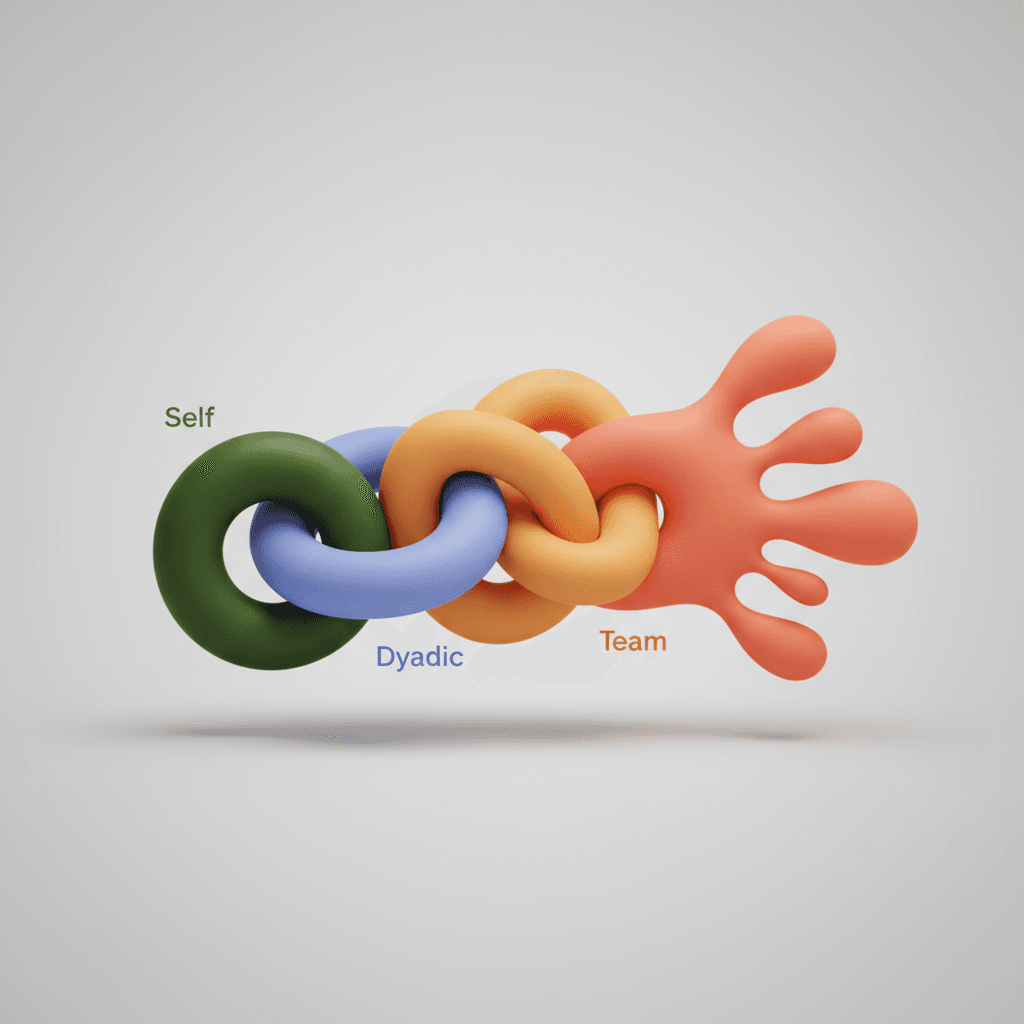
The Four Domains of EQ: Self, Dyadic, Team, and Organizational
Most EQ models stop at the individual. Here's why that's a problem - and how a four-domain framework gives you the full picture.